
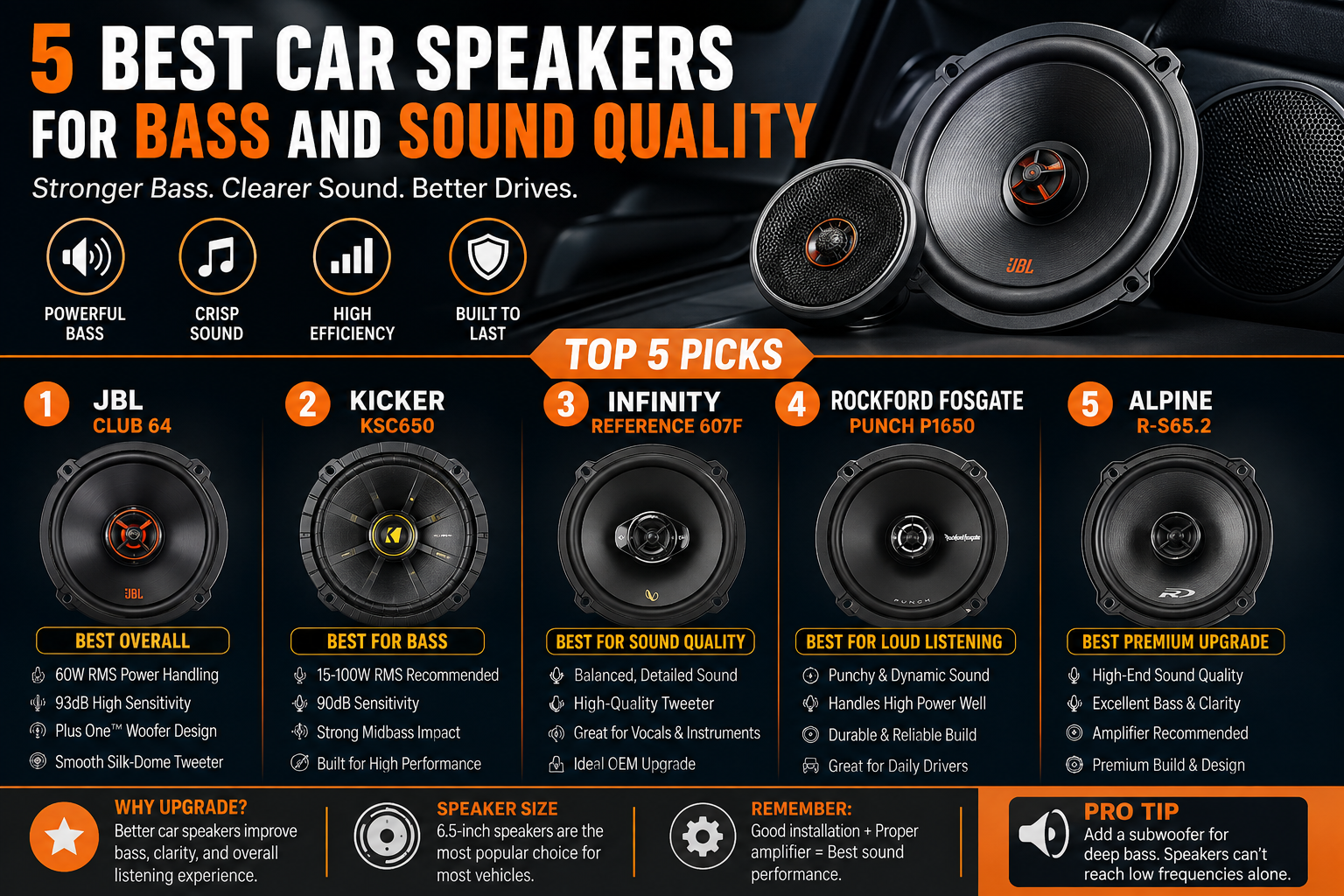
5 Best Car Speakers for Bass and Sound Quality to Buy
If you want better bass from your car audio system without sacrificing vocals, detail, and overall sound quality, replacing the factory speakers is one of the most effective upgrades you can make. Factory speakers are usually designed around cost, weight, and basic functionality rather than deep midbass, clean dynamics, or accurate high-frequency reproduction.
For this guide, I focused on speakers that balance bass response, clarity, power handling, sensitivity, build quality, installation flexibility, and long-term upgrade potential. I also looked closely at how each speaker is likely to perform from a factory head unit versus an aftermarket amplifier.
My top overall choice is the JBL Club 64 because its high sensitivity, 3-ohm impedance, large effective cone area, and smooth silk-dome tweeter make it a particularly strong all-around replacement speaker. However, there are better choices if maximum power handling, aggressive midbass, or future amplification is your priority.
Best Car Speakers for Bass and Sound Quality: Quick Picks
- Best Overall: JBL Club 64
- Best for Powerful Bass: Kicker KSC650
- Best for Sound Quality: Infinity Reference 607F
- Best for High-Volume Listening: Rockford Fosgate Punch P1650
- Best Premium Upgrade: Alpine R-S65.2
Important: Even excellent 6.5-inch car speakers cannot reproduce true sub-bass like a dedicated subwoofer. When I refer to “bass” in this guide, I primarily mean strong, controlled midbass and upper-bass impact. If you want powerful output below roughly 50–60 Hz, I recommend adding a subwoofer.
Quick recommendation: For a straightforward factory-speaker replacement, I would start with the JBL Club 64. For a system that will eventually include an amplifier and subwoofer, I would lean toward the Kicker KS or Alpine R-Series.
Best Car Speakers for Bass and Sound Quality Comparison
| Speaker | Size | Power Handling | Sensitivity | Best For | My Rating |
|---|---|---|---|---|---|
| JBL Club 64 | 6.5″ | 60W RMS | 93 dB @ 2.83V | Best Overall | 9.3/10 |
| Kicker KSC650 | 6.5″ | Up to 100W recommended amplifier power | 90 dB | Bass & Dynamics | 9.1/10 |
| Infinity Reference 607F | 6.5″ | Model-dependent system matching | High-efficiency design | Clarity | 9.0/10 |
| Rockford Fosgate Punch P1650 | 6.5″ | Aftermarket upgrade class | Efficient coaxial design | Loud Listening | 8.9/10 |
| Alpine R-S65.2 | 6.5″ | High-power aftermarket class | Amplifier Recommended | Premium Systems | 9.2/10 |
Decision Matrix
| Model | Bass | Clarity | Factory Radio | Amplified System | Value |
|---|---|---|---|---|---|
| JBL Club 64 | 9.0/10 | 9.3/10 | 9.6/10 | 8.8/10 | 9.5/10 |
| Kicker KSC650 | 9.3/10 | 8.9/10 | 8.8/10 | 9.4/10 | 9.2/10 |
| Infinity Reference 607F | 8.7/10 | 9.5/10 | 9.3/10 | 9.0/10 | 9.2/10 |
| Rockford Fosgate Punch P1650 | 9.1/10 | 8.7/10 | 8.7/10 | 9.1/10 | 9.0/10 |
| Alpine R-S65.2 | 9.2/10 | 9.4/10 | 8.2/10 | 9.7/10 | 8.7/10 |
1. JBL Club 64 – Best Overall Car Speakers for Bass and Sound Quality
Best for: Drivers who want noticeably better bass and clarity without immediately installing a large amplifier.
My Rating: 9.3/10
The JBL Club 64 is my top overall recommendation because it addresses one of the biggest problems with factory speaker upgrades: limited available power.
These 6.5-inch two-way speakers are rated at 60 watts RMS and 180 watts peak, with a 93 dB sensitivity rating at 2.83V and a nominal impedance of 3 ohms. JBL also specifies a frequency response of 48 Hz to 21 kHz.
Bass Performance
JBL’s Plus One woofer architecture increases the effective cone area available within the speaker frame. More usable cone area can help move more air, which is exactly what I want from a door speaker when bass performance matters.
Don’t expect subwoofer-level bass. Instead, the Club 64 is about giving kick drums, bass guitar, electronic music, and lower male vocals more weight than weak factory speakers normally provide.
The relatively high sensitivity is another advantage. A speaker can have excellent power handling but still sound disappointing when connected to a low-powered factory radio. The Club 64 is much easier to recommend in that situation.
Sound Quality
The edge-driven silk-dome tweeter is one of my favorite aspects of the design. Silk tweeters generally suit listeners who want detail without excessively sharp highs.
That balance matters inside a car because reflective surfaces such as glass can make an already bright tweeter sound tiring.
Build Quality and Durability
JBL uses an acoustically damped, UV-resistant polypropylene woofer cone. That is a sensible material choice for a vehicle, where speakers have to survive heat, humidity, temperature changes, vibration, and years of door operation.
Pros & Cons
Pros
- Strong efficiency
- Good midbass for a 6.5-inch coaxial
- Smooth silk-dome tweeter
- Works well with modest power
- 60W RMS power handling
- Good factory-speaker upgrade
Cons
- Still cannot replace a dedicated subwoofer
- 3-ohm design requires sensible system matching
- Higher-end component systems offer better imaging
Best Overall: If I wanted one speaker upgrade that balances bass, efficiency, clarity, price, and installation simplicity, the JBL Club 64 would be my first choice.
2. Kicker KSC650 – Best Car Speakers for Powerful Bass
My Rating: 9.1/10
If bass impact and energetic listening are higher priorities than a relaxed presentation, the Kicker KSC650 deserves serious consideration.
The KSC650 is a 6.5-inch two-way speaker with a 4-ohm impedance and 90 dB sensitivity. Kicker specifies a recommended amplifier power range of 15–100 watts RMS and a frequency response extending from approximately 43 Hz to 21 kHz.
Why I Like It for Bass
The Kicker makes sense when you want your front doors to contribute meaningful punch rather than simply reproduce vocals and treble.
Its ability to accept substantially more amplifier power than many entry-level replacement speakers also gives it a useful upgrade path. You can install the speakers first and add a four-channel amplifier later.
That matters because bass requires power and cone movement. If you want strong midbass at higher listening levels, additional clean amplifier power can make a major difference.
Performance
I would pair these with proper door treatment whenever possible. A 6.5-inch woofer mounted to a thin, vibrating metal door cannot perform at its best. Adding speaker gasket material and strategically applied sound deadening can improve perceived punch and reduce rattles.
Pros & Cons
Pros
- Strong midbass potential
- Good power handling
- Works particularly well with an amplifier
- Wide frequency range
- Excellent future upgrade potential
Cons
- Less sensitive than the JBL Club 64
- A factory radio may not reveal its full potential
- A subwoofer is still necessary for serious low-frequency extension
Choose the Kicker KSC650 if: You listen to hip-hop, EDM, rock, or other bass-heavy music and plan to add an amplifier later.
3. Infinity Reference 607F – Best for Sound Quality and Detail
My Rating: 9.0/10
The Infinity Reference 607F is the option I would consider when sound quality takes priority over simply making the system louder.
Infinity’s Reference family has traditionally focused on combining efficient aftermarket performance with detailed high-frequency reproduction. That makes the 607F particularly attractive for daily drivers where factory amplification may remain in place.
Sound Character
For sound quality, I pay attention to more than treble detail. A good speaker should make vocals easy to distinguish, preserve instruments during complex passages, and maintain tonal balance when the volume increases.
The Infinity is especially compelling for acoustic music, vocals, jazz, pop, and mixed playlists where clarity is as important as bass.
Bass Quality vs. Bass Quantity
I would characterize the Infinity approach as more focused on controlled bass than exaggerated bass. That’s important because excessive upper-bass output can initially sound impressive while masking vocals and lower midrange detail.
If you plan to add a powered subwoofer, this becomes an even stronger combination. Let the Infinity speakers concentrate on midbass through treble while the subwoofer handles deep frequencies.
Pros & Cons
Pros
- Excellent clarity
- Balanced presentation
- Good choice for vocals and instruments
- Suitable for factory-system upgrades
- Strong foundation for a subwoofer-equipped system
Cons
- Not my first choice if maximum midbass output is the only goal
- System installation has a major effect on final bass response
- Enthusiasts may eventually prefer separate components
Choose the Infinity Reference 607F if: You care more about clean, balanced music reproduction than simply maximizing bass output.
4. Rockford Fosgate Punch P1650 – Best for Loud, Dynamic Listening
My Rating: 8.9/10
The Rockford Fosgate Punch P1650 is an easy model to shortlist if you want an energetic car-audio sound with good impact and volume capability.
Rockford Fosgate has a long history in aftermarket car audio, and the Punch line sits in an appealing position between inexpensive factory replacements and considerably more expensive audiophile systems.
Bass and Dynamics
What makes the P1650 interesting for this comparison is its focus on delivering useful cone area and strong output from a conventional coaxial format.
For rock, hip-hop, metal, and electronic music, I would generally prioritize dynamics over an ultra-soft presentation. The Punch is aimed squarely at that type of listener.
Installation
Fitment matters more than many buyers realize. A speaker that looks like the correct diameter can still have problems with mounting depth, bolt patterns, window mechanisms, factory grilles, or electrical connectors.
Before buying any P1650—or any speaker in this guide—I recommend checking vehicle-specific fitment rather than assuming every 6.5-inch speaker is interchangeable.
Pros & Cons
Pros
- Energetic presentation
- Good bass punch
- Strong aftermarket-car-audio pedigree
- Good choice for louder listening
- Useful upgrade from weak OEM speakers
Cons
- Listeners seeking a softer presentation may prefer JBL or Infinity
- Installation quality strongly influences bass performance
- Deep bass still requires a subwoofer
Choose the Rockford Fosgate P1650 if: You want a fun, powerful daily-driver system with plenty of energy.
5. Alpine R-S65.2 – Best Premium Car Speakers for Bass and Sound Quality
My Rating: 9.2/10
The Alpine R-S65.2 is my premium-oriented choice for someone building a more serious aftermarket audio system.
This is the direction I would take if the speaker replacement is only the first part of a larger build involving amplification, better source processing, door treatment, and eventually a subwoofer.
Performance
The advantage of moving into this category isn’t simply additional volume. Higher-quality speakers tend to maintain better control as output increases.
That’s important because distortion can make a system seem loud while simultaneously making it unpleasant to listen to.
With clean amplifier power and proper crossover settings, the Alpine R-Series can form the front stage of a genuinely capable car-audio system.
Upgrade Path
This is where I think the Alpine makes the most sense. If you’re eventually planning to install a DSP, four-channel amplifier, sound-deadened doors, and subwoofer, buying a more capable speaker now can prevent you from replacing your speakers again later.
Pros & Cons
Pros
- Excellent sound-quality potential
- Strong midbass capability
- Designed for more serious aftermarket systems
- Good performance at higher output levels
- Excellent long-term upgrade path
Cons
- More expensive than basic replacement speakers
- Benefits significantly from external amplification
- Overkill for some factory-radio-only installations
Choose the Alpine R-S65.2 if: You’re building a complete audio system rather than simply replacing damaged factory speakers.
Technical Specification Comparison
| Model | Configuration | Nominal Size | Power Requirement | Ideal Setup |
|---|---|---|---|---|
| JBL Club 64 | 2-Way Coaxial | 6.5″ | 60W RMS rated | Factory Radio / Amp |
| Kicker KSC650 | 2-Way Coaxial | 6.5″ | 15–100W RMS recommended | Factory Radio / Amp |
| Infinity Reference 607F | 2-Way Coaxial | 6.5″ | Moderate | OEM Upgrade |
| Rockford Fosgate P1650 | 2-Way Coaxial | 6.5″ | Moderate | OEM / Aftermarket |
| Alpine R-S65.2 | 2-Way Coaxial | 6.5″ | Higher | Amplified System |
What Makes a Car Speaker Good for Bass?
The biggest mistake I see when comparing car speakers is focusing on peak wattage. Peak power tells you very little about how a speaker will actually sound.
For bass and overall sound quality, I pay more attention to RMS power handling, sensitivity, cone area, excursion capability, installation quality, crossover configuration, impedance, and available amplifier power.
Speaker Size
All else being equal, a larger woofer has more surface area and can move more air. That’s why 6.5-inch and 6×9-inch speakers are generally more useful for bass than tiny dashboard speakers.
Sensitivity
Sensitivity becomes especially important if you’re keeping the factory radio. A high-sensitivity speaker can produce more output from limited power.
This is one reason I rank the JBL Club 64 so highly for factory-system upgrades.
RMS Power Handling
Ignore enormous “MAX POWER” numbers on inexpensive speakers. RMS or continuous power handling is much more useful when matching speakers with an amplifier.
Door Installation
Your car door effectively becomes part of the speaker enclosure. A poorly sealed speaker mounted to a flexible, rattling door can lose much of its bass potential.
I recommend using proper mounting adapters, foam sealing rings, and sound-deadening treatment where practical.
Coaxial vs. Component Speakers for Sound Quality
A coaxial speaker places the tweeter and woofer together. This makes installation easier and usually less expensive.
A component system separates the woofer and tweeter and normally includes a dedicated crossover. Components offer more flexibility for positioning the tweeter and creating a higher soundstage.
If I were performing a simple OEM replacement, I would choose coaxials. For a serious front-stage build with amplification and DSP tuning, I would usually choose components.
You can learn more in my component vs coaxial speakers comparison.
Do You Need an Amplifier?
Not necessarily.
Efficient speakers such as the JBL Club 64 can provide a worthwhile improvement from many factory or aftermarket head units. But an amplifier becomes increasingly important when you want higher volume, stronger dynamics, and cleaner bass.
More importantly, an amplifier should provide clean power. Sending a heavily clipped signal from an underpowered system can sound worse than using moderate clean power.
If you’re planning a complete system, see my guide to the best car amplifiers.
Do Better Car Speakers Give You More Bass?
Yes, but only to a point.
Replacing lightweight factory speakers with higher-quality aftermarket speakers can improve midbass punch, control, and overall bass definition. However, even a premium 6.5-inch speaker has physical limitations.
If you want to feel frequencies around 20–50 Hz, a dedicated subwoofer is the correct tool.
My preferred system is therefore not “bass-heavy door speakers instead of a subwoofer.” It’s quality door speakers plus a properly integrated subwoofer.
My Ideal Upgrade Path
- Replace weak front factory speakers.
- Improve speaker mounting and seal the doors.
- Add sound deadening where necessary.
- Add a quality amplifier.
- Add a subwoofer for frequencies the door speakers cannot reproduce efficiently.
- Add DSP or advanced EQ if you want better imaging and tonal accuracy.
This approach usually produces a more balanced result than spending the entire budget on extremely expensive speakers while ignoring installation and amplification.
Who Should Buy These Speakers?
These recommendations make the most sense if you:
- Want better bass than your factory speakers provide
- Want clearer vocals and treble
- Listen to music at moderate or high volume
- Want less distortion from your car audio system
- Are building an aftermarket audio system gradually
- Want speakers that can eventually work with an amplifier
Who Should Avoid Them?
You should reconsider a conventional speaker upgrade if your primary goal is enormous deep bass. In that situation, I would prioritize a car subwoofer and appropriate amplifier.
You should also confirm fitment before ordering. Speaker diameter alone does not guarantee compatibility with your vehicle.
How I Evaluated These Car Speakers
I don’t think it is useful to rank speakers solely by manufacturer power ratings. For this comparison, I evaluated each model using the factors that have the greatest practical effect on a real car-audio installation.
My scoring framework gives particular weight to:
- Bass performance – 25%: Midbass potential, cone design, usable frequency range, and power capability.
- Sound quality – 25%: Expected tonal balance, treble design, clarity, and ability to remain controlled at useful listening levels.
- Power compatibility – 15%: How easily the speaker can work with factory power and/or aftermarket amplification.
- Build quality – 10%: Cone, surround, tweeter, basket, and automotive durability considerations.
- Installation and compatibility – 10%: Practicality as an OEM replacement.
- Upgrade potential – 10%: Whether the speaker still makes sense after adding an amplifier or subwoofer.
- Value – 5%: Overall capability relative to its market position.
I also distinguish between deep bass and midbass. I don’t award unrealistic scores to a 6.5-inch speaker because a door speaker simply cannot replace a properly designed subwoofer.
Expert Score Summary
| Speaker | Bass | Sound Quality | Build | Compatibility | Overall |
|---|---|---|---|---|---|
| JBL Club 64 | 9.0 | 9.3 | 9.1 | 9.5 | 9.3 |
| Kicker KSC650 | 9.3 | 8.9 | 9.2 | 9.0 | 9.1 |
| Infinity Reference 607F | 8.7 | 9.5 | 9.0 | 9.2 | 9.0 |
| Rockford Fosgate P1650 | 9.1 | 8.7 | 9.0 | 8.9 | 8.9 |
| Alpine R-S65.2 | 9.2 | 9.4 | 9.5 | 8.7 | 9.2 |
Best Alternatives
If none of these five models fits your vehicle or system, I would also look at higher-end JBL Stadium speakers, alternative Infinity component systems, Alpine component speakers, and vehicle-specific replacement packages.
For vehicles with factory premium audio systems from Bose, JBL, Harman Kardon, Bang & Olufsen, or similar manufacturers, impedance and factory amplifier compatibility become particularly important. I would not replace those speakers based on physical size alone.
Frequently Asked Questions
What are the best car speakers for bass and sound quality?
The JBL Club 64 is my best overall choice for buyers seeking a combination of strong midbass, high sensitivity, smooth treble, and easy system integration. The Kicker KSC650 is an excellent alternative when bass impact and amplifier compatibility are higher priorities.
Which car speakers have the best bass?
For the five models in this comparison, I would choose the Kicker KSC650 when midbass output is the priority. However, no 6.5-inch door speaker will produce the same deep bass as a dedicated subwoofer.
Are 6×9 speakers better for bass than 6.5-inch speakers?
They can be. A 6×9 speaker has greater cone area than a typical 6.5-inch speaker and can potentially produce stronger bass. Final performance still depends on speaker design, available power, installation, and the vehicle’s mounting location.
Can I get good bass without a subwoofer?
You can get satisfying midbass without a subwoofer, particularly with quality 6.5-inch or 6×9-inch speakers mounted correctly. For deep sub-bass and the physical impact associated with bass-heavy music, I still recommend a subwoofer.
Do I need an amplifier for aftermarket car speakers?
No. High-efficiency aftermarket speakers can work well from a factory head unit. An external amplifier becomes more useful when you want greater output, stronger dynamics, and cleaner performance at higher volume.
Will aftermarket speakers make my car louder?
Potentially. Sensitivity and impedance affect how much output a speaker produces from the available amplifier power. A highly efficient aftermarket speaker can sound noticeably stronger than an inefficient factory speaker.
What wattage is good for car speakers?
For most daily-driver systems, speakers capable of handling roughly 50–100 watts RMS per channel can provide excellent performance when properly matched with an amplifier. Don’t choose speakers based solely on peak wattage.
Is JBL or Kicker better for bass?
I prefer JBL when efficiency, balanced sound, and factory-radio compatibility are priorities. I would lean toward Kicker when I want an energetic presentation, strong midbass, and an upgrade path involving more amplifier power.
Should I replace all four car speakers?
Not always. If the budget is limited, I prefer spending more on the front speakers because they have the greatest influence on the front soundstage. Rear speakers can be upgraded later.
Does sound deadening improve speaker bass?
It can. Reducing door-panel vibration, improving the speaker mounting surface, and limiting acoustic leakage can help a door speaker produce cleaner and more convincing midbass.
Final Verdict
After comparing these five options, the JBL Club 64 is my pick for the best car speakers for bass and sound quality for the widest range of installations.
Its combination of 60-watt RMS power handling, 93 dB sensitivity, 3-ohm nominal impedance, Plus One woofer design, and silk-dome tweeter makes it especially attractive when upgrading factory speakers without immediately rebuilding the entire audio system.
For more aggressive bass and a future amplifier upgrade, I would choose the Kicker KSC650. If clarity and tonal balance matter most, the Infinity Reference 607F is my sound-quality-focused option. The Rockford Fosgate Punch P1650 suits drivers who enjoy an energetic, high-output presentation, while the Alpine R-S65.2 is my choice for a more ambitious amplified system.
My Final Ranking
- JBL Club 64 – Best Overall
- Alpine R-S65.2 – Best Premium Choice
- Kicker KSC650 – Best for Bass
- Infinity Reference 607F – Best for Sound Quality
- Rockford Fosgate Punch P1650 – Best for Loud Listening
Which One Should You Buy?
Most people: JBL Club 64
Bass-focused system: Kicker KSC650
Sound-quality system: Infinity Reference 607F
Loud daily-driver system: Rockford Fosgate Punch P1650
Premium amplified build: Alpine R-S65.2
Before ordering, always verify the speaker diameter, mounting depth, impedance, factory amplifier configuration, and connector requirements for your specific vehicle. The best speaker on paper will not deliver its potential if it is poorly matched or poorly installed.

I’m Tim George Jr., a former professional race car driver who spent years pushing high-performance vehicles to their absolute limits—from the high-speed ovals of NASCAR’s ARCA Racing Series to grueling road courses. Driving at that level gives you an unmistakable, visceral feel for how a machine should perform, handle, and hold up under pressure.
After hanging up my racing helmet, I shifted my passion for motorsport toward helping everyday drivers, car enthusiasts, and gearheads make smarter decisions. Today, I test, analyze, and review automotive products—everything from performance tires, brake upgrades, and synthetic oils to track-day gear, diagnostic tools, and essential car care accessories.